Comparing Consensus: Bitcoin, Ethereum, and Logos
How does Logos' Cryptarchia consensus compare to Bitcoin's Nakamoto consensus and Ethereum's Gasper?

Understanding the trade-offs between different consensus mechanisms is crucial for building resilient, private, and truly decentralised blockchain networks. After extensive research, the Logos team designed Cryptarchia to serve as a tailor-made consensus protocol for the Logos Blockchain. This article explores how Cryptarchia, compares to traditional Proof of Work (PoW) protocols like Bitcoin and more familiar Proof of Stake (PoS) protocols like Ethereum’s Gasper, evaluating each protocol based on privacy, barriers to entry, and finality properties.
Background
Why Do We Need "Proof of" Anything, Anyway?
In a previous article, we discussed the basic properties of a blockchain and how PoW and PoS consensus protocols ensure that these properties are maintained when faced with malicious behaviour. However, it's worth taking a step back to review a fundamental point: why is it necessary for block proposers to do work or prove ownership of token stake at all?
In a permissionless network in which anyone can participate, we need mechanisms to ensure that the correct operation of the blockchain cannot be compromised. This is accomplished by adding a cost to participation, making it necessary to do some computational work (for PoW) or to own tokens (for PoS) in order to propose a block. Assuming that a majority of computational power or economic stake is controlled by honest participants, introducing a cost ensures that dishonest parties will not be able to succeed against the honest majority via Sybil attacks.
The CAP Theorem Trade-off: Safety vs Liveness
One of the most fundamental choices in consensus design is how the protocol handles catastrophic network failures. This choice is often framed through a restatement of the CAP theorem: do we prioritise safety (ensuring the chain never forks) or liveness (ensuring block production continues)?
Chains prioritising safety, such as many BFT-based protocols, halt when they cannot reach consensus rather than risk forking. This requires quorum-based consensus with a known set of participants and extensive communication between them. These systems typically impose high barriers to entry through large staking requirements or governance processes.
In contrast, chains prioritising liveness - including Bitcoin, Ethereum, and the Logos Blockchain - continue producing blocks even during a failure. They rely on fork choice rules rather than quorums, allowing them to remain permissionless and tolerate up to 50% dishonest participants. While finality may be delayed during catastrophic failures, the network remains operational and accessible no matter what. The Logos team explicitly chose to prioritise liveness over safety, optimising for resilience and decentralisation at the cost of immediate finality.
Three Approaches to Consensus
To better understand the design choices that lead to the creation of Cryptarchia, we will compare it to two well-known consensus protocols that also optimise for liveness: Bitcoin and Ethereum consensus.
Bitcoin's Proof of Work
Bitcoin's PoW requires miners to find a nonce such that the hash of the block header falls below a target difficulty - a computational puzzle that is expensive to solve but cheap to verify. Miners compete to be the first to publish a block with an acceptable header. In case of a fork, the chain with the greatest amount of blocks is consistently selected as the correct chain in a process known as the longest-chain fork choice rule. The protocol, also known as Nakamoto consensus, is simple, battle-tested, and provides strong security guarantees - but at the cost of enormous energy expenditure, barriers to entry, and privacy issues.
Ethereum's Proof of Stake
Ethereum transitioned to PoS during The Merge of 2022, replacing a reliance on computational work with economic stake. Validators lock up 32 ETH to participate in block proposal and vote on the correct chain. The Gasper protocol uses validator committees and a complicated fork choice rule to achieve faster finality than pure Nakamoto consensus. However, this finality comes at the cost of increased implementation complexity.
Logos Blockchain: Private Proof of Stake
Cryptarchia is the Logos Blockchain’s probabilistic consensus protocol, combining the simplicity and resilience of Nakamoto consensus with the energy efficiency of Proof of Stake and the privacy guarantees of zero-knowledge cryptography. Time is divided into slots, with a decentralised leadership lottery run by participants for each slot. Participants can prove that they won the lottery through a zero-knowledge proof that doesn't reveal their stake amount. Winners propose blocks, and the network uses a variant of the longest-chain fork choice rule to resolve conflicts.
As stated in the Cryptarchia specification: "The values that Cryptarchia optimizes for are resilience and privacy. These come at the cost of block times and finality." With these properties in mind, we can proceed to compare the three consensus protocols.
Privacy Considerations
Proposer privacy is Cryptarchia’s most unique feature, distinguishing it from the pseudonymous nature of Bitcoin and Ethereum consensus.
Bitcoin: Pseudonymous but Linkable
Mining Bitcoin can be done pseudonymously, since miners can use different addresses for each block reward. However, several factors compromise proposer privacy. For example, most blocks are mined by identifiable pools, with pool signatures often included in the coinbase transactions that begin a new block. In addition, since the first node to broadcast a block is typically its miner, network analysis can be used to build profiles. Even when excluding pool signatures and using a secure mixnet to publish new blocks, the electricity requirements of Bitcoin mining at any significant scale make it difficult to hide.
Block rewards can also be traced through subsequent transactions via graph analysis, potentially linking miner identities. While Bitcoin transactions can be anonymised via techniques such as CoinJoin, these are not foolproof. Bitcoin was designed primarily to serve as a decentralised digital currency, with privacy not being a priority. When done right, it can obfuscate miner identity to some extent - but not enough to truly be considered a private blockchain.
Ethereum: Registered Staking
Ethereum's transition to Proof of Stake improved energy efficiency but introduced new privacy challenges distinct from Bitcoin's PoW model. Unlike Bitcoin's pseudonymous mining, Ethereum validators must register publicly with 32 ETH deposits. Each validator has a public index and key, making their participation transparent and traceable. Additionally, the amount staked by each validator is publicly visible on-chain, allowing observers to track validator wealth and calculate their relative stake.
As a consequence of the LMD GHOST fork-choice rule used by Gasper, validators must broadcast attestations (votes) for each epoch, creating a public record of their activity. This activity can easily be used to link validators to the nodes hosting them, leaking information like IP addresses and geographic locations. In addition, block proposers are selected pseudo-randomly but the schedule is published at the beginning of each epoch (group of 32 slots). Observers can see in advance which validator will propose each block, enabling targeted attacks.
While Ethereum validators can be totally decoupled from nodes via the use of mixnets and firewall devices, these are expensive solutions with very high bandwidth requirements. Ultimately, the fundamental architecture requires public stake amounts and validator identities. This transparency serves important purposes for accountability and slashing, but comes at the cost of validator privacy and potential censorship risks.
Cryptarchia: Private Proof of Stake
Cryptarchia was designed from the ground up with proposer privacy as a core principle. This philosophy manifests in two key privacy properties. First, the leadership lottery is run locally by each participant using zero knowledge proofs. No global announcement reveals who won or how much stake they hold, and no leader schedule is published. An adversary cannot infer a validator's relative stake from their on-chain activity alone.
Second, the protocol ensures unlinkability between block proposals and their proposers. When combined with the Blend Network (the Logos Blockchain’s anonymous broadcasting protocol), proposals are cryptographically and temporally obfuscated, making it extremely difficult to connect a block to its creator. While Cryptarchia does have certain privacy limitations, including a vulnerability to tagging attacks and leaders as a single point of failure, these are less critical than those facing Bitcoin and Ethereum, and are expected to be reduced in future version of the protocol.
Barriers to Entry: External vs Internal Costs
One of the most significant differences between PoW and PoS systems lies in the nature of their participation costs. In Proof of Work systems like Bitcoin, participation requires continuous external expenditure that can create significant barriers to entry. To gain an edge or remain competitive, miners must purchase specialized hardware such as ASICs, which represent substantial upfront capital costs. Additionally, they face ongoing electricity costs proportional to their mining activity, along with expenses for cooling, facilities, and maintenance. These external costs favor economies of scale and have led to mining centralisation in regions with cheap electricity. However, they also ensure that attacking the network requires sustained external spending, making long-range attacks prohibitively expensive.
PoS protocols, by contrast, rely on costs internal to the blockchain’s own economic system. This cost can also be understood as the opportunity cost of maintaining the stake required to participate in consensus. While Ethereum requires significant stake (32 ETH) to be locked up in order to serve as a validator, a Logos note of any value can participate in the leadership lottery, with winning probability proportional to its value. In addition, notes can be added or withdrawn at will, with the only caveat being that notes used in recent transactions are ineligible for consensus participation. These internal costs promote decentralisation by allowing small holders to participate meaningfully.
Finality and Block Times
As consensus protocols that favour liveness, Bitcoin, Ethereum’s Gasper, and Cryptarchia all tolerate forks to some extent. However, to remain secure, they must ensure that these forks will certainly (or almost certainly) be resolved after some period of time. Doing so ensures that blocks older than this period are treated as immutable, or final. These finality times differ between the various consensus protocols, depending also on the time it takes to create and publish a new block (the block time).
Bitcoin: Simple and Secure
Bitcoin consensus is designed to be simple and secure. New blocks are added by miners whenever a miner generates a hash value below the target. This target is adjusted periodically to ensure a consistent block production rate of approximately one block every 10 minutes. While any Bitcoin transaction can be reversed if its block ends up being excluded from the chain, this becomes increasingly unlikely as more blocks are added with the desired block in their chain. In practice, waiting for a transaction to be 6 blocks deep (about 1 hour) is considered to be safe practice. However, newly-mined coins cannot be spent before the coinbase transaction is 100 blocks deep (about 16 hours), enforcing stronger finality guarantees for these coins.
Ethereum’s Gasper: Fast but Complex
Despite putting an emphasis on liveness, Ethereum’s Gasper consensus protocol was designed to decrease finality times by strengthening its safety properties. As a PoS protocol, it divides time into discrete units called slots, with a validator having the ability to propose at most one block per slot - about 12 seconds at the time of writing. Unlike in PoW, block time is independent of the difficulty of becoming a proposer and is instead identical to the slot length. Ethereum’s finality gadget allows transactions to reach finality quickly, in about 13 minutes. However, due to its complexity, the Gasper consensus protocol has had some serious security issues. While Ethereum has introduced patches to fix these issues, the inherent complexity and novelty of the protocol makes it liable to have other, as of yet undiscovered, vulnerabilities.
Cryptarchia: Instantly Assured Ordering
Unlike Gasper, Cryptarchia allows for any number of blocks to be produced in a slot, with a block time of 30 seconds. This behaviour leads to many more chain reorganisations compared to Gasper, which threatens safety by potentially changing the order of transactions. To combat this, Cryptarchia introduces a novel mechanism to ensure correct transaction ordering, known as Mantle channels.
The purpose of Mantle channels on Cryptarchia is to immediately enforce the correct ordering of transactions. These channels form virtual “chains” on top of the Logos Blockchain, with each transaction in a channel referencing its predecessor via a hash. Mantle channels ensure that their transactions will eventually be included on-chain in the correct order, regardless of how the Logos Blockchain may fork or reorganise. This allows new transactions that depend on earlier ones to be submitted immediately, without waiting for finality. An example with two channels is shown below in Figure 1.
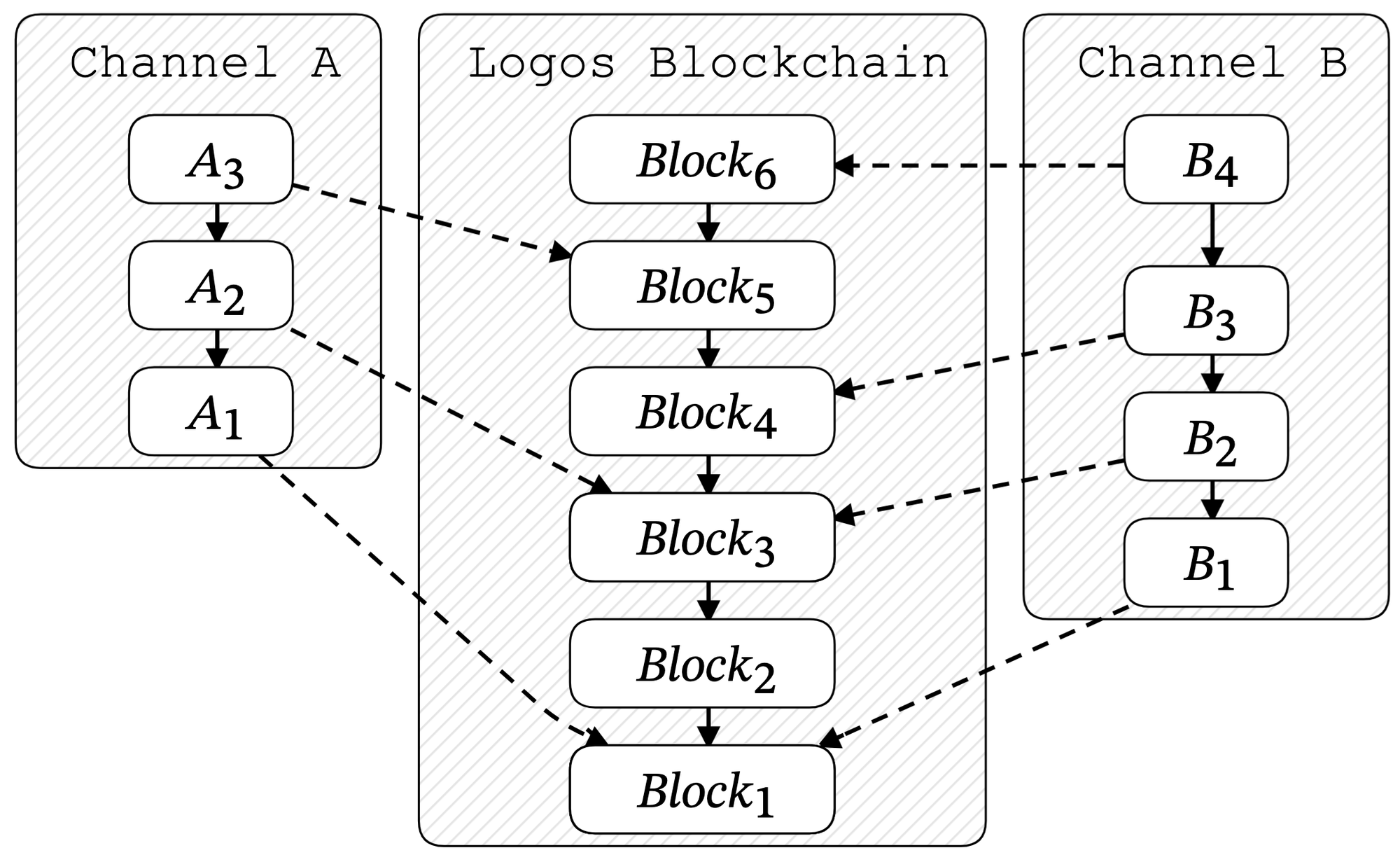
It is important to note that Mantle channels can only be relied on if the sequencer is trusted to act honestly. In the absence of this assumption, users must wait for the true blockchain finality - about 18 hours at the time of writing.
Conclusion
Every consensus protocol has to make some fundamental tradeoffs to best fit its use case. Bitcoin's Proof of Work offers battle-tested security through external costs, but sacrifices energy efficiency and proposer privacy. Ethereum's Gasper achieves faster finality and lower energy consumption, but is very complex and requires public validator registration with high entry barriers. Cryptarchia charts a different path entirely - one that prioritises proposer privacy and accessibility while maintaining the resilient simplicity of Nakamoto consensus. Through zero-knowledge proofs and the innovative Mantle channels, it demonstrates that privacy and decentralisation need not be sacrificed for usability.
For more information about Logos, be sure to visit our website and join the official Discord server.